Found in these Departments

Ships from: BooksCloud
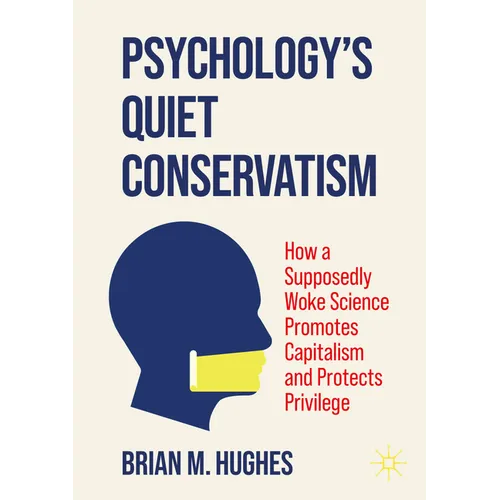
Psychology's Quiet Conservatism: How a Supposedly Woke Science Promotes Capitalism and Protects Privilege - Paperback
Psychology's Quiet Conservatism: How a Supposedly Woke Science Promotes Capitalism and Protects Privilege - Paperback
In stock
Couldn't load pickup availability
by Brian M. Hughes (Author)
What if psychology isn't as liberal as we think?
Psychology is often seen as a progressive discipline -- a champion of social justice, diversity, and liberal values. But this provocative book challenges that assumption. It argues that psychology, from its historical entanglements with eugenics and colonialism to its modern-day focus on individualism, has long served to reinforce the status quo. Even as many psychologists identify as politically liberal, the field's methods, theories, and institutions often promote a worldview that downplays inequality, pathologizes dissent, and resists structural change. Psychology's emphasis on personal responsibility, resilience, and self-help frequently aligns more closely with conservative ideals than with progressive ones. This book explores how the myth of a "liberal bias" in psychology has been weaponised in today's culture wars -- and how it distracts from the field's real political blind spots. It asks: what would it mean for psychology to truly live up to its promise of promoting human welfare? Accessible, deeply researched, and sharply argued, Psychology's Quiet Conservatism is essential reading for anyone interested in how science shapes society -- and how society shapes science.Back Jacket
"A penetrating, timely, and very accessible exploration of the deep and continuing right-wing political biases in mainstream psychology."
-- Fathali M. Moghaddam, author of How Psychologists Failed
"A scathing review and critique of the discipline... a marvellous insider account."
-- Ian Parker, University of Manchester, UK
"This profound work should be required reading for all psychology students and beyond."
-- Thomas Teo, York University, Canada
What if psychology isn't as liberal as we think?
Psychology is often seen as a progressive discipline -- a champion of social justice, diversity, and liberal values. But this provocative book challenges that assumption. It argues that psychology, from its historical entanglements with eugenics and colonialism to its modern-day focus on individualism, has long served to reinforce the status quo.
Even as many psychologists identify as politically liberal, the field's methods, theories, and institutions often promote a worldview that downplays inequality, pathologizes dissent, and resists structural change. Psychology's emphasis on personal responsibility, resilience, and self-help frequently aligns more closely with conservative ideals than with progressive ones.
This book explores how the myth of a "liberal bias" in psychology has been weaponised in today's culture wars -- and how it distracts from the field's real political blind spots. It asks: what would it mean for psychology to truly live up to its promise of promoting human welfare?
Accessible, deeply researched, and sharply argued, Psychology's Quiet Conservatism is essential reading for anyone interested in how science shapes society -- and how society shapes science.
Brian M. Hughes is Professor of Psychology at the University of Galway, Ireland. A leading expert in stress, health, and the public understanding of science, he is a prominent commentator and advocate for evidence-based policy. His books include A Conceptual History of Psychology (2022), The Psychology of Brexit (2019), and Psychology in Crisis (2018).
Author Biography
Brian M. Hughes is Professor of Psychology at the University of Galway, Ireland. A leading expert in stress, health, and the public understanding of science, he is a prominent commentator and advocate for evidence-based policy. His books include A Conceptual History of Psychology (2022), The Psychology of Brexit (2019), and Psychology in Crisis (2018).
Share